Latest Entries »

If you look online for tutorials involving sticky stabilizer, you are told to cut your length of the stabilizer and then put it, paper back and all, into the outside hoop.  You are then told to score an area and pull off the paper to expose an area that you can adhere your fabric to.

I dislike this method because ultimately the hoop loses tension on the stabilizer (the paper is slippery!), and the fabric being embroidered can, and usually does, start to pucker and shift, especially when doing the complicated overs and unders of a Celtic knot. I hate puckering and will do all I can to avoid it. I have yet to have a perfect embroidery sample, but I am working on it.

I will illustrate what I do using one of my large hoops for my commercial machine, but the same idea can be used on home embroidery machines.


As you can see above, having come off of a roll, the stabilizer is curled.  To get started, I lay the inner hoop ring right side up on the paper side of the sticky back to flatten the curl as shown below.


Then, I begin to pull the paper backing off the piece of sticky stabilizer.

With the hoop still weighing the stabilizer down, I pull the paper off one end.

Then I move the hoop end onto the exposed sticky stabilizer.

I rub the stabilizer onto the bottom and a bit of the side of the hoop.  Then, holding the hoop, I pull the rest of the paper off so that the hoop “catches” the stabilizer.

Attaching the stabilizer evenly around the hoop can take some patience.

This next pic shows the sticky back attached tightly…when I thwack it with my finger it sounds like a drum.

Next, I cut a piece of tear away stabilizer…

…and then hoop the whole shebang.

(Since I now mainly use a rectangular border frame which means there is nothing to hold the tearaway in place, I just wait until I am ready to stitch to slide the tearaway under the hoop.  The basting box or placement lines or even just the first stitches of a design catch the tearaway and hold it in place.  And since the sticky back does cause a buildup on the needle that causes more thread breaks, I have taken to adding a piece of waxed paper  from the baking section in between the sticky back and the tear away.  This keeps the needle lubricated so that I have very little build up and very few breaks.) 

You will notice when stitching out designs using the sticky back stabilizer that I have added a basting box around the design.  In the pic below, you can see the faint line of the basting box.

(There is some good background info here: Pursuing the Perfect Embroidery Stitch-out.)

If you look online for tutorials involving sticky stabilizer, you are told to cut your length of the stabilizer and then put it, paper back and all, into the outside hoop.  You are then told to score an area and pull off the paper to expose an area that you can adhere your fabric to.

I dislike this method because ultimately the hoop loses tension on the stabilizer (the paper is slippery!), and the fabric being embroidered can, and usually does, start to pucker and shift, especially when doing the complicated overs and unders of a Celtic knot. I hate puckering and will do all I can to avoid it. I have yet to have a perfect embroidery sample, but I am working on it.

I will illustrate what I do using one of my large hoops for my commercial machine, but the same idea can be used on home embroidery machines.

As you can see above, having come off of a roll, the stabilizer is curled.  To get started, I lay the inner hoop ring right side up on the paper side of the sticky back to flatten the curl as shown below.

Then, I begin to pull the paper backing off the piece of sticky stabilizer.

With the hoop still weighing the stabilizer down, I pull the paper off one end.

Then I move the hoop end onto the exposed sticky stabilizer.

I rub the stabilizer onto the bottom and a bit of the side of the hoop.  Then, holding the hoop, I pull the rest of the paper off so that the hoop “catches” the stabilizer.

Attaching the stabilizer evenly around the hoop can take some patience.

This next pic shows the sticky back attached tightly…when I thwack it with my finger it sounds like a drum.

Next, I cut a piece of tear away stabilizer…

…and then hoop the whole shebang.

(Since I now mainly use a rectangular border frame which means there is nothing to hold the tearaway in place, I just wait until I am ready to stitch to slide the tearaway under the hoop.  The basting box or placement lines or even just the first stitches of a design catch the tearaway and hold it in place.  And since the sticky back does cause a buildup on the needle that causes more thread breaks, I have taken to adding a piece of waxed paper  from the baking section in between the sticky back and the tear away.  This keeps the needle lubricated so that I have very little build up and very few breaks.)

You will notice when stitching out designs using the sticky back stabilizer that I have added a basting box around the design.  In the pic below, you can see the faint line of the basting box.

Next, your applique fabric must be interfaced and then stabilized with fusibles.  This interfacing and stabilizing helps the fabric stand up to what can be very dense stitching.  Whether or not your base fabric is stabilized with a fusible interfacing (tricot or woven) is totally up to you. After the fabric is interfaced, I fuse Pellon Decorbond to the areas to be embroidered.  This is fairly stiff interfacing which helps support the stitches.  Yes, there is softer, cheaper stuff, but I have found it does not work as well as I want it to.  I sometimes use two layers of this when making patches depending on the the base applique fabric I have chosen.

I will explain making this file into an applique patch:

Once you have hooped the sticky back and the tear-away, unless you are just covering the hoop area with fabric to start, placement stitches will run on the sticky back to indicate where to lay the fabric:

Now, lay your interfaced and stabilized fabric in the hoop.  The following basting box and tackdown stitches will run (I run 2 tackdowns to help alleviate any fraying of the fabric which happens often with the types of fabrics we use in Irish dance.):

Then the following knots will stitch out:

After the knots finish,  I stop and remove the hoop for trimming. (I program a stop on a commercial machine.)

Remove the hoop from your machine.  Cut very closely to the outside stitching as shown below (obviously using different examples!):

Photobucket

Then, put the hoop back on your machine and finish the outside satin stitching:
At this point, the patches may start to separate from the sticky back which is why you do not want to have pulled the sticky too tightly when attaching it to your hoop.  If it is too stretched, the patch will definitely pull away and shift and the final satin stitching will be faulty.

Using other patches as an example, I will show you how I finish them.  Here, the patch stitching is done. You can see the perforations around the patches but no huge holes…the patches are still in the right place!
Photobucket

Before removing the patches, I run a line of Fraychek on the back edge of the of the outside satin stitching. Then, I punch them out.
PhotobucketPhotobucket

As you can see, there is a fine fuzz surrounding the patches. This is from both the sticky and tear away stabilizers. This needs to be trimmed away using either use my appliqué scissors or my fine, curved embroidery scissors.
Photobucket

Here they are trimmed. I can get closer with the smaller scissors…obviously the trick here is to trim closely without cutting threads which the Fraycheck actually helps with as it has sealed the edges which protects those threads. Since the edge embroidery thread is white, this is where I stop. When the outside satin stitch is a colored thread, I use either a permanent Sharpie or a fabric dye pen in the right color prior to applying the Fraycheck, and I color in the outside edge so all the white is gone, then trim when it is dry.

PhotobucketPhotobucket

I sometimes then iron a fusible web to the back of the applique to hold the patch securely in place when I the sew around the edge.  My preferred way of sewing around the patch is to use a clear monofilament, and using the outside satin stitching as a guide, I use a wide zig-zag to attach the patch flush to the fabric.

So there I was, working on some shawl patches for a client.  Beautiful silk velvet…I would be happy in silk velvet sheets.  I was using the sticky back stabilizer in my hoop because these are patches, so everything was prepped the way I always do, the topper was doubled, all was basted into place…and 20 stitches in, the thread breaks.  I re-thread the machine, rub the needle with some silicon to help things along, and re-start.

15 seconds later, the thread breaks again.  I fix it, re-start…10 seconds later it breaks again.  My ears are starting to steam mainly because every time a thread breaks, my machine BEEPS & BEEPS & BEEPS in a high pitched tone that drives me insane.  Just so this blog does not become x-rated, suffice it to say that my frustration hit dangerous levels and I almost knocked that machine through the wall.

Why was this happening?  Well, because I was embroidering on SILK velvet on top of sticky back.  The silk shed more fibers than anything I have ever used and it also picked up huge amounts of the gummy stuff so that every few seconds, I had a ball of stuff at the top of a thoroughly coated needle and the machine would have a fit.  I cleaned it out top to bottom to no avail.

I resigned myself to standing there, in front of my machine, taking deep, cleansing breaths, swearing up a blue streak as these little patches that should have taken 30 minutes tops, including fabric trimming, took me 2 1/2 hours.

That same day, I get an email from Colleen Murphy.  I had just sent her some designs for her daughter’s dress, and because she was having to re-hoop for a big bodice design, she was using sticky back…and her thread was not only breaking, it was shredding!  The dressmaking gods were in a really bad mood.

I called Susan.  I am thinking there has to be a way around this, that there has to be a way to coat the needle with something that will repel the gummy silk lint and help Colleen.  Susan and I start tossing it around, and suddenly, Susan says, “Waxed paper.”  Ooo.  Was this another genius moment?

She and I talk a bit about whether or not to use it on top or the under the sticky back, but I do not remember now if we came to a conclusion.

I write Colleen back with several suggestions, including the waxed paper idea.

She writes back to say it worked beautifully.  Her thread stopped breaking and shredding.  I was psyched because I was prepping a big skirt job using what looked, felt and behaved like more silk velvet.  Colleen used it on top of her solvy topper, so I asked her if it left any tiny pieces.  She said no, that she was happy with the way it looked.

First thing I have to do is make two long appliques for a belt for this dress which meant I had to trim this velvet which was going to leave all sorts of silk fibers everywhere which was really going to test this waxed paper theory.  I took a breath, put the waxed paper over the solvy topper, and began.

The first applique, after trimming, stitched out without a single break.  15 inches of dense stitching with metallic thread…45 minutes of non-stop embroidering.  I was stunned.  There is always a break or two, sometimes more with metallic threads.

The next applique only stopped once.

Here they are:

11 by you.

And Colleen was right, the paper just came right off, no bits.

So, I do a test for the skirt design using a different velvet, but I use the waxed paper anyway, just to see what happens with this design.  Here are pics of the process:

Waxed paper over the solvy, basted in place – 6 by you.

Stitching out beautifully…not a single break – 7 by you.

Finished design, paper beautifully perforated – 8 by you.

Tearing it off first – 9 by you.

But this time, there are little bits that I cannot overlook – 10 by you.

See the “rough” edges?  I start to pick all of those off, but I know that if I have to do this on 13 separate pieces of embroidery on this skirt, I might lose my mind.  This will make me very cranky.

I contemplate putting the waxed paper under the sticky back, but something tells me that might be a moot point.  So, what if I put it on top of the sticky back?  But then why use sticky back at all since it won’t be serving its purpose of anchoring the fabric in place so I can hoop it according to the placement lines on the skirt?

So I try it this way:

(See the end of this post for simpler instructions if the thought of being this ANAL makes you twitch!)  Around the design area, I added extra placement lines that were then stitched out onto the sticky back –   5 by you.

Using half the design template, I cut pieces of waxed paper – 7 by you.

I laid a piece on one side of the central placement line – 8 by you.

…and the second half on the other side – 9 by you.

I left an open area of sticky between the 2 pieces – 10 by you.

Why?  Because I did not want my center line to slip around as I was placing the fabric on the sticky back.  I also had the sticky exposed around the design area to hold the fabric as well.

So, I stitched out the design…with no breaks, no huge lint and gum build up – 3 by you.

And I am doing a little jig around my embroidery room –4 by you.

I ripped off the solvy fast to get this pic, so there are a couple of pieces, but it looks great!  Much better!

Is it more work?  Yep, but sitting there pulling all the ittybittyteenytiny pieces of waxed paper off would take me WAAAYYYY longer.

Yeah, genius moment, Susan.

UPDATE:  I could not continue to be this anal, so now I just hoop a length of waxed paper under the sticky back, and off I go.  In fact, because I have now found the best sticky back ever (strong and thicker) I do not always use a tearaway as long as the fabric is fused with a good woven cotton.  Works beautifully!

Ok,  pic of the first test:

(One of these days I will really learn to use one of my photo software packages so I can make pics like this the best they can be, but no time now.  So sorry that they are not perfect.  And yes, there are pieces of thread that I did not trim…it’s a test!!))

The youngest diva and I stood there and watched a lot of this stitch out.  You would think it was all magic the way we become so fascinated.  I would be lying if I said my attention to it is purely professional as I am just as excited watching the stitches take shape as my 8 yr-old is, but I do also learn a lot about the designs and things I need to fix by watching the machine do its thing.

If you look closely at the above pic, you can see some rippling, some shadows, and off-kilter lines.  Why?  Because I got lazy, and I still needed to adjust some stitch densities.  My laziness means I did not prep the fabric the way I would the actual dress pieces, so the fabric could not stand up to the stitches which caused a lot of rippling and nap diving (burrowing into the velvet) even though I still used a topper.  My bad…however, I think that may also have helped to make it very clear where I still needed to adjust stitch densities and satin stitch widths.

A bit closer here:

  This one gives a sense of how small this all is as you can see some microscopic dust (a decorating choice in this house), and the weave of the velvet!  You can also see how off center things got because I did not stabilize well enough.  You’d think I was a rookie…

So, I spent a few hours re-working the designs, checking and adjusting every line and shape…I dreamed all night long that the blue feathers on the eagle kept growing and changing and re-swirling different directions.  Do you think my embroidery dreams are evidence of psychosis??

My embroidery hubris made me take my next test a bit more seriously.  I interfaced the velvet first with a woven fusible then fused Decorbond to that.  After I hooped my sticky back, I then used a heavy duty tear away behind that…I contemplated using 2 layers of the tear away, but worried that might have been an overkill that would cause skipped stitches.

This test was much better all the way around.

There are still some shadows from the nap of the velvet, but no rippling or nap diving.  All of the braid lines stayed lined up though I still went back into the design files to make the satin stitch even just a bit wider to try to fill in the remaining gaps between the satin stitch columns and the back stitch outlines.

Here is the eagle that haunted my dreams:

The winged lion:

The gryphons and a braid:

The nessies:

Bodice front with the birds, serpent braid, and red braids…you can see clearly here that the satin stitch inside the braids needs to be wider…that just bugs me!

And lastly the vertical braids which also got a bit more tweaking after this:

I sent the test piece off to Colleen who will see the family that wants the reproduction at a feis this weekend…is it CNY?  Colleen called me when she got it this afternoon, and she was as excited as I am about this little thing!  So nice to hear her voice.  One of these days I hope I get to meet some of my fellow dressmakers in person…such great people!

ETA:  More curve on the learning curve!  We decided to use a gold metallic in place of the tan thread in the designs.  It was a particular kind of metallic from Madeira meant to be strong.  Yeah…so freaking strong that my machine would not cut it so this is what the stitch out looked like!

3 by you.

Yuck, boo, hiss!!!  No time to find a similar color in a different thread, so I went back in to re-do the embroidery sequence.  Thank goodness I consider this kind of challenge to be FUN!!

I wrote about the beginning of this journey here:  Newest Endeavor

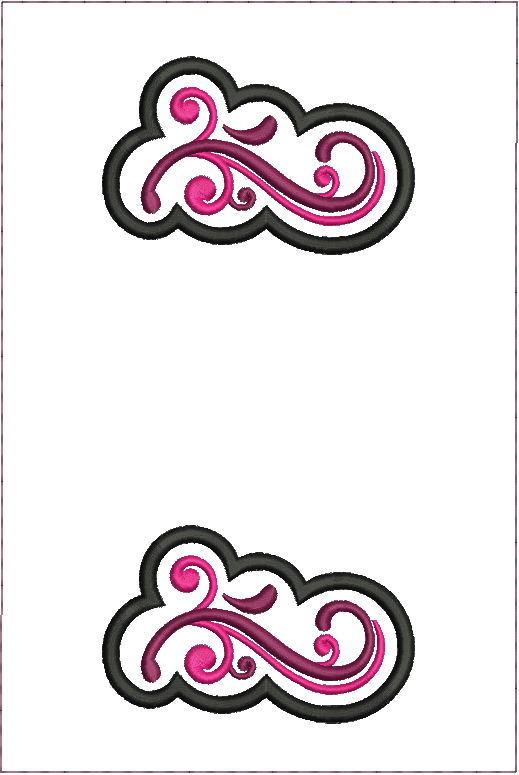
Many digitizing software packages now come with an automatic applique function.  Call me old-fashioned or cranky, but once again the logic of the one in my software escapes me.  I spend more time cleaning it up and removing excess steps than I do actually digitizing the whole thing myself!  And I do one extra step that helps me avoid fraying fabric pieces which is important considering some of the unusual fabrics we ID dressmakers use.

This is what I do.

  • Prep the fabric.  I use a fusible interfacing and either a good fusible stabilizer (Decorbond) or I fuse Wonderunder to the back so that the piece can be fused to the base.
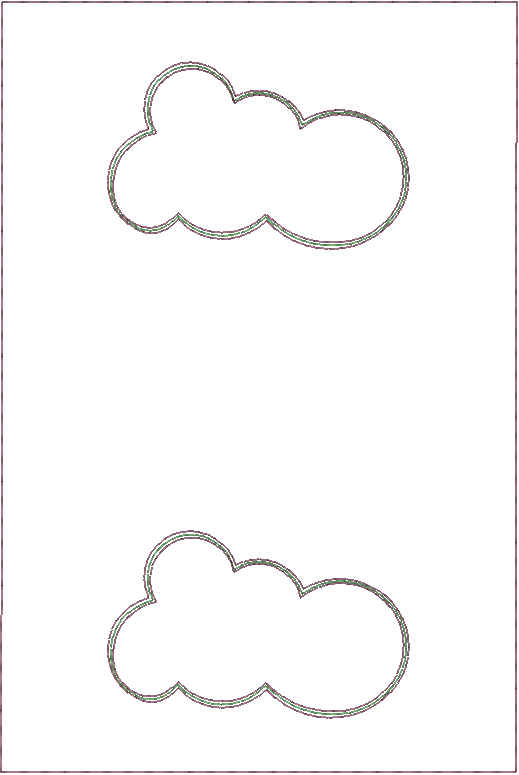
  • I outline my shape with a running stitch as below.  (To conserve fabric, I will stitch this out onto my base fabric first so that I can see where to place the applique fabric to avoid waste.  This is also a way to ensure placement of pieces already cut to size.  Many people do it that way.)app 1 by you.
  • Next, I duplicate the above shape.  (This will be the initial tack down.  After this line is stitched, I can trim the fabric.)app 2 by you.
  • I duplicate the shape again…app 3 by you.
  • …and change it to a satin stitch.app 4 by you.
  • I do not digitize in a separate zig-zag or step tack down as my satin stitch is preceded by this underlay…app 6 by you.
  • …which is then followed by the satin-stitch.app 4 by you.
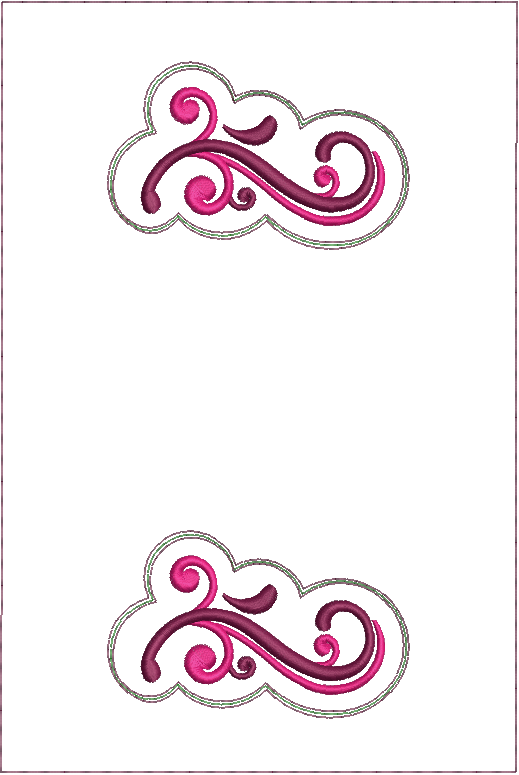
  • Now, before I do the final satin stitch, I usually run a line of Fraycheck along the tack down stitch before I trim.  This helps seal the fabric to prevent fraying.  However, sometimes fraying will still happen depending on the fabric, so I have taken to digitizing in a second running stitch tack-down line.app 7 by you.
  • Then I apply the Fraycheck, and then I trim very closely to that outside line.  Finish with the satin stitch. 
  • app 4 by you.

I routinely field questions from dressmakers with home embroidery machines about whether or not they can do large bodice designs that require one or more re-hoopings.  The answer is always, “Of course you can!!”  

I have yet to find a design I can’t re-hoop, but I am honest with dressmakers about the complexity of re-hooping some designs.   In most cases, the dressmakers are game, so along with the split files I send detailed instructions written for their files complete with pictures.  Sometimes, when the design is big enough to need 4 re-hoopings or the design requires extreme precision to line up contiguous lines, then the dressmaker may send the fabric to me so I can do it in a big hoop on my commercial machine, but there have been brave, adventurous souls who still want to do it themselves…my kind of dressmakers!!

Do you need big hoops?  I have always assumed so since I have always had the mega-hoop for my Bernina and learned to use the Hoop-it-alls to expand my range, but I have had dressmakers use only their 4 x 4 inch hoops…that blew my mind, but they were determined!  And I do understand that determination…never occurred to me NOT do something because it did not fit into my hoop.  These were all done using my Bernina 200E:

Yes, each entire panel, edges and all, were done in the hoop with 1 re-hooping.

And my favorite of all time, my first, the one that was made all the more blissful by my ignorance!!! 

molly by you.molly cape by you.

I re-hooped all  of these parts in the most convoluted, complicated way possible!  In fact, I had started on this (I learn by jumping in with both feet…or headfirst) before I went to take some lessons for my Bernina machine and software.  I was having trouble with the logic of the sleeve design, so I brought the file (as well as the front skirt panel) with me so the teacher could look at it.  She took one look at the size of the file and told me it could not be done…every time I tried to get her to focus on my question, she simply said what I wanted to do could NOT be done on my machine.  I finally whipped out the finished front panel (5 re-hoopings) to show her I could do it, I just had a question!!!  She had no answer.  Instead she asked me how I managed that front panel, but at that point my process was so twisted that I really could not articulate clearly.  It was a big sigh day.

My friend Kris is working on this dress:

Dressmaker & Embroiderer: Kristine Baker
Designer & Digitizer: Me (AD 6)

IMG_1693 by krispy_b2000.

 The beginning of the directions that I send begin with a little pictorial about using sticky back stabilizer…

(The following information is for the home sewer using a home machine.)

There are online tutorials that show how to use the water-soluble stuff called Badgemaster. I love the stuff for patches that can be washed.  Patches for Irish dance dress very often are made with fabrics that cannot be washed, so this is another approach.  The result is the same.

I use a LOT of this stuff –
Photobucket

If you look online for tutorials involving this sticky stabilizer, you are told to cut your length of the stabilizer and then put it, paper back and all, into the outside hoop as below.
Photobucket

Then you are told to score an area…
Photobucket

…and pull off the paper.
Photobucket

I dislike this because ultimately the hoop loses tension on the stabilizer (that paper is slippery!), and the fabric being embroidered can, and usually does, start to pucker and shift, especially when doing the complicated overs and unders of a celtic knot. I hate puckering and will do all I can to avoid it. I have yet to have a perfect embroidery sample, but I am working on it.

I pull the paper backing off the entire piece of sticky back stabilizer…
Photobucket
…and attach it to my inner hoop.
Photobucket

This next pic shows the sticky back attached tightly…when I thwack it with my finger it sounds like a drum. (Please excuse my “dirty” hoop…that is fabric dust, thread, sequins, etc, embedded in spray adhesive from my attempts to use the stuff years ago. It never goes away, but it is not bothering me or my fabrics!)
Photobucket

Then I cut a piece of tear away stabilizer…
Photobucket

…and then hoop the whole shebang.
Photobucket

(There is more info here: Pursuing the Perfect Embroidery Stitch-out! )

(Note: There is one thing that I do for myself when stitching out designs using the sticky back stabilizer – I add a basting box around the design. In the pic below, you can see the faint line of the basting box.

finished 005 by you.

Once the placement stitches are sewn onto the hooped stabilizers and the fabric is then lined up on the sticky stabilizer, the next thing to get stitched out is a long basting stitch around the design area.  This ensures that the fabric will not move or pull or come away from the sticky stabilizer.  I have also found that it helps eliminate any puckering. Some machines will add a basting outline with a push of a button. For others, this can be added to the embroidery files.

However, some velvet will very often be permanently marked by these stitches. Test a scrap by sewing and removing some basting stitches onto a scrap.I have found that crushed velvet can take it, but the shorter pile of regular velvet cannot always.

If your velvet cannot take a basting stitch, it is best to find ways to keep the fabric from shifting as it still can once the stitching starts even on the sticky back. I have a little stash of pins that I bent into curves to secure my fabric to the sticky back when I can’t use the basting stitches.)

I highly recommend you do a test stitch-out first.

Now, let’s understand your digitized files.

Bodice: This bodice design has been split into 4 sections. The black lines are the basting stitch reference lines in the stitch files.

kris curl bodice

Here are the 4 separate files:

bodice 1kris bodice 1 center bottom kris bodice bottom

right shoulderkris bodice right side left shoulder kris bodice left side

You will start with “bodice 1.” Below are the pics of the file and the placement lines in the file.

kris bodice 1  kris bodice 1 placement lines (This is not a separate file.)

Now, if this were me, I would have my fabric prepped and marked (not cut out to size yet) as I explain here: Pursuing the Perfect Embroidery Stitch-out!  

I would have the center line of the bodice marked as well as the line I wanted the top of the middle of the desing to begin at.  The lines on the bodice would look like this:

judy curl bodice 1 placement lines center lineThis will correspond to the same lines in the file.
 
Now, once the hoop is ready, the placement lines in the first color (black in the file, but this could just be the first embroidery color you will be using) get stitched out onto the sticky stabilizer NOT on the fabric. You can stitch them onto your fabric if the fabric will not retain the needle marks, but as long as the interfacing is not removed, the lines will stay on the back for placing for the next file (the center line itself will be mostly covered by the stitching anyway). (For your test run, I would stitch all placement lines on the fabric.)

So, once the placement lines are stitched, place your fabric in the hoop, lining up your drawn line with the placement line as shown in Pursuing the Perfect Embroidery Stitch-out!
Stitch out “bodice 1.”

Remove from the hoop and remove excess stabilizer. Be careful not to remove or pull on the first set of placement lines.

Re-hoop the sticky back and the tear away for the next part.

You will continue with “bodice left side.” Below is the pic of the file.

kris bodice left side   judy curl bodice 2 left shoulder placement lines(This is not a separate file.) 

Stitch out the black placement lines.

Line up the placement lines from Part #1 on the fabric piece with the new black lines. Use the points where the lines cross as your center points for each placement. Finish stitching part 2.

Remove from the hoop and remove excess stabilizer. Be careful not to remove or pull on the first set of placement lines. Re-hoop the sticky back and the tear away for the next part.

Part #3: You will continue with “bodice right side.” Below is the pic of the file.

kris bodice right side  judy curl bodice 3 right shoulder placement lines(This is not a separate file.)

Stitch out the black placement lines.

Line up the placement lines from Part #2 on the fabric piece with the new black lines. Use the points where the lines cross as your center points for each placement.

Finish stitching part 3.

Part #3 is finished. Remove from the hoop and remove excess stabilizer. Be careful not to remove or pull on the first set of placement lines.

Part #4: You will continue with “bodice bottom.” Below is the pic of the file.
kris bodice bottom  bottom bodice 1 placement lines

Stitch out the black placement lines.

Line up the placement lines from Part #3 on the fabric piece with the new black lines. Use the points where the lines cross as your center points for each placement.

Finish stitching part 4.

Part #4 is finished.

Remove from the hoop and remove excess stabilizer. Remove placement line threads.

Et, voila!
IMG_1693 by krispy_b2000. 

As I stated above, I highly recommend doing a test stitch out.  Perhaps there are superwomen dressmakers who can do this right the first time, but weirdness happens! 

Many thanks to the dressmakers who send me pics of their re-hooped confections!

Dressmaker & Embroiderer: Molly Lafayette
Designer & Digitizer: Me

Molly Lafayette 1, AD 12 by you.

Dressmaker & Embroiderer: Judy Poole
Designer, Digitizer: Me  

Judy Poole AD 11 by you.

Dressmaker & Embroiderer: Judy Poole
Designer, Digitizer: Me  

Judy Poole front by you.

Dressmaker & Embroiderer: Lisa Horn
Designer, Digitizer: Me  (Revised AD 6: Curls)

DSCF4530 by you.

Dressmaker & Embroiderer: Mary Reilly
Designer, Digitizer: Me

Mary Reilly finished bodice 1 by you.

You can see these dresses and more in the Taoknitter Arts Customer Creations gallery.

A while back, dressmaker Colleen Murphy contacted me about collaborating on a very cool project: an ID dress reproduction of a full sized, hand embroidered velvet dress…for an American Girl doll!  I was intrigued so, of course, said yes.

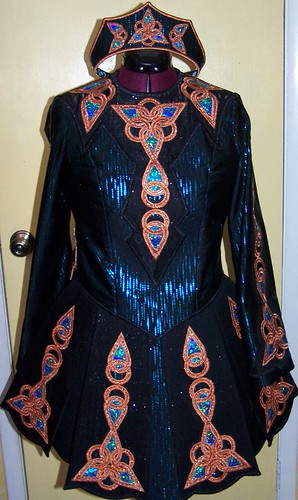
The original dress is unbelievable!  Black velvet, orange crocheted collar, and some of the most interesting & beautiful Celtic/Irish hand embroidery I have ever seen.  I will admit to being intimidated on SOOO many levels, but the challenge could not be ignored.

Colleen is game for me to write about this, and I will include pics of my work, but I will not post pics of the original dress until I am sure it is ok with the owners.

Photos arrive…and I sit there and stare…and stare…and stare some more.  So many things are going through my head about  colors, stitches, faithful reproduction, artistic license… have I bit off more than I can chew?  I dreamed about this dress and how the gryphons and lions chased me while I was trying to thread a needle! 

My biggest obstacle was dealing with my “feelings,” my philosophy on faithful reproduction.  Besides the fact that neither my embroidery software nor machine can manage a chain stitch, there is the integrity of someone else’s artwork to consider.  As you may know, I am a retired dance professor/dancer/choreographer/artistic director…the issues of artistic integrity are part and parcel of who I am on so many levels.  My master’s degree encompassed directing and Labanotation/movement analysis, and it is this training in Labanotation in particular that honed my focus on/obsession with faithful reproduction. 

Labanotation is dance notation, a logical though complex system of symbols and rules used to first record dance and then to reconstruct it again on new people, sometimes decades later.  If you are interested, you can learn more here: Labanotation.

Not long after I got to grad school at Ohio State, I changed my concentration to include Labanotation.  I was fascinated by and drawn to this extremely logical approach to dance.  Now, I am sure my professors would tell you they shook their heads many, many times at my emo approach to dance in general, but I will never forget the day I let the logic take over…Vera Maletic gave me a very rare smile and nodded her head before turning away to bark at me to do it again!  Not only did my symbols need to precisely record illogical movement, but when I read notated scores and performed them, it better look the way Doris Humphrey demanded decades before!  It was a very intense LOVE/HATE relationship.

So, here I was 24 years later, looking at someone else’s beautiful art with the intention of reproducing it.  I swear I felt Vera thwack the back of my skull.

The animals were glaring at me, so I chose a knotwork braid to start with.  That I could handle easily.

vertical braids by you.

Now, I have not ever done anything as small as was going to be required here, but I knew that I could not do this the way I would if it were going to remain full size.  So, even though I did the original digitizing in a decent size, instead of outlining all of this with a satin stitch, I chose a backstitch to approximate both the look of the chain stitch outlines and to accommodate what I knew would end up being very narrow lines.  But, after doing this design, I knew I was going to have to do a test dress to get a real feel for the size and to get a sense of stitch density for something as small as the designs on an AG dress.

Colleen sent me pics of her pattern pieces & dimensions so I could digitize the outlines to use as templates.  I then used one of my designs.  Even though I have not done mini-designs, I have enough experience by now to know that if I used the same stitch density that I use for the ID designs, I was going to be tunneling to China!!  Too many stitches in such a small area was only going to pull in, and perhaps make holes in the fabric no matter the pull compensation, so I lightened the density a lot.  Here’s the result:

dolltestdress 011 by colmurph2000.

And here is it finished…I am so tempted to buy an AG doll for the youngest Diva!

AG test dress by you.

(I feel the need to say here that I so admire that Colleen likes doing these little dresses, and she does them so well!  I have this psychotic aversion to sewing things with small pieces which is why I am not a quilter…these dresses qualify as beautiful small things that make me twitch!  I know I do applique with small pieces, but like every other psycho, it is the context…it goes on a BIG dress.)

So, I learned I was right about stitch density.  The test turned out well…and everyone in my family got a big kick out of this tiny little dress.  Even the macho hubby talked to it like it was a gerbil…

The next design I tackled was what I call the Nessies:

nessies by you.

This design took me days.  Why?  Because I kept finding myself mired in choices…colors (decided Colleen can match colors since she has the dress, but still wanted to match as closely as possible so the client could have a visual); stitches (leave plain or play with texture?); overs and unders (fix them so that they make sense or keep them as they were originally stitched?); symmetry (make things perfectly symmetrical as I imagine they were intended and as I can with the computer or stay true to the actual pics keeping in mind that over the years the fabric changes and hangs differently now?); handmade look versus computerized perfection…haven’t there been more than a few artists driven insane by the demands of their art?!?  Ya know Van Gogh and that ear…???

I cannot count the number of times I would find myself just sitting in front of the computer contemplating the photos…I imagined how much of it was done in the company of other women doing exactly the same thing.  I wondered how many mistakes occurred and were then simply incorporated because the embroiderer got caught up in a conversation with her fellow stitchers.  I wondered how often the zen of the repetitive needlework sent the embroiderer on a quiet journey of her own…and then I would start.

I decided that if this were me doing the hand stitching, I would work for symmetry.  I would work for the logical progression of the overs and unders, but I would get over myself when the logic failed.  I decided I would follow the handmade lines but clean things up when unique moments took on the aura of a mistake.  I decided I would try to keep the look of its handmade beauty while using my technology to enhance it where applicable.  I decided less was more…and that was hard!!

And this is what I have so far:

vertical braids by you.birds by you.

nessies by you.

winged lion by you.

serpent braid by you.

eagle by you.

braid by you.

waist braid by you.

griffins by you.

And here are the dress pieces:

reproduction front skirt by you.

reproduction skirt back by you.

reproduction bodice by you.

This weekend, I will do another test.  I will post pics of it, succeed or fail.

There is a new thread on Celtic Flame about stealing designs.  A dressmaking mom writes that another mom in her school told her she was wasting her time coming up with her own designs because there was so much to COPY on the internet.  When she first wrote, she alluded to a website that sells embroidery, so I wondered if she might be talking about Taoknitter Arts.

An answer that she just posted to another reply makes me think she is talking about my website.

Big sigh. 

Susan and I have hashed out the pitfalls of posting clear pics of the designs since I started.  She has dealt with this issue far longer than I have, and I respect her viewpoint, her advice and her experience.  I will not bore you, or myself, by re-visiting  the mental gymnastics (complete with teeth gnashing) that helped me arrive at the current presentation of the designs on my website.  If you look at it, I think you get it.

But, I do want to say that I know I take the risk of people copying things.  I have this tendency to believe that all folks are inherently honest and honorable.  I do, routinely, get blind-sided by self-serving idiots with an overdeveloped sense of entitlement, and I sometimes finally get really irked by stupidity and mean-spiritedness, but I have yet to see a change in my basic trust.  I now know what it sounds like when Susan shakes her head at me over the phone.

It would make me crazy to try to police things or try to find a more complicated way of managing the designs.  But let me be clear, copying a design is stealing and I am not shy about approaching the thief and making it public if I have to.  I did, by accident, see an exact copy of a dress I made for my daughter.  Susan designed it for us.  The design was never made available, but there it was, perfectly copied on someone else’s dress.  When I contacted the overseas dressmaker, she was great about it, very sorry, and told me that the design had been given to her by the dancer. 

I get contacted rather often by dancers who send me pics of designs from other dresses, even BN dresses, wanting THAT design digitized.  Sometimes I get a design “created by the dancer” only to be led by the dressmaking gods to pics of the EXACT design on a finished dress…that blows my mind.  Once I explain that I will not copy because it is both unethical and illegal, they usually calmly explain that they did not know that and we go forward.  Only once did I not hear back after my refusal…I think that was embarrassment.

I do think most folks either do not know or really do not think about it.  One poster on CF wrote: ” I think the problem is that most people don’t equate “appropriating” someone’s design as stealing because they don’t physically take something.  It isn’t like shoplifting where you actually take something in your hand.

It’s more like cheating on a test.

Ask your friend if she encourages her dd to copy her neighbor’s answers on exams in school. Why not? It is just what she did. She used someone else’s work and passed it off as her own.

Ask her if she’s going to brag about how she aquired her designs – Wow look what I copied off of the internet and I didn’t have to pay for it! If someone asks her where the design came from, is she going to say “Oh I digitized it myself” or something equally evasive. If she’s so proud of her cleverness, why not tell all?

Ask her if she thinks the TC will be happy if she finds out the design was lifted. Is she OK with her school being known as the one where it is OK to rip off other people’s dresses?”

Interesting viewpoint.

Susan made me laugh when she pointed out that truly, the only thing I should worry about is if someone else’s poorly digitized “copy” was thought to be mine!  Now that would be a drag!

There was also a point made by someone about using designs from a site on the internet.  She wrote: “While there are a couple of sites out there that have drawn up several dress designs specifically for irish dancing use, you have to remember then, that your dress won’t be an original. Chances of running into another dancer with the same pattern are slim but just something to keep in mind.

That mind set has never occurred to me!!  Yes, yes, I know that the conversation about whether or not a BN dress is really custom when they re-use designs in part or in whole pops up routinely.  But, it has always been my assumption that each dressmaker brings a totally different perspective to making a dress and so it will be rare that 2 dressmakers will use the same design the same way let alone the same fabrics.  In fact, what I love about my clients is that they always do something I did not envision.  Very often, they ask me to modify the designs by taking something out, putting something else in, taking it apart or trying something new with a piece of something else!  I love it.

Still, I guess that is a concern for some people.  I appreciate that.  And I also thoroughly appreciate my creative dressmaking clients.  Thank you for spurring me on!

I thought that the above might have been a rant…I guess it was just a bit of mental popcorn…

There are a couple of links in this brief post about Copyright Law: Substantial Similarity.

Big, big, multiples sighs…the Sneetches are at it once more.  Dressmakers are being accused of “highway robbery” again. So that I can maintain a detached, calm stance, I am going to assume that is mainly directed at the BNs (big names).

It has not yet been said in the voy board post to which I am referring that “it is only embroidery for pete’s sake, not the artistic applique of not-so-long-ago!” Let me be clear here that I am in awe of the MANY appliqued works of art that were done without the benefit of digitizing. Susan Gowin’s work stuns me every time, and I drool over The Silverlode dresses. Amazing. I completely appreciate the time and artistic talent.

By the same token, all the embroidery that we are seeing on the dresses these days is equal in the amount of time and even talent that it takes to create the designs, digitize them well, and then stitch them out (ok, maybe there is no artistry in using a computerized machine, but it is still time intensive and takes mechanical understanding and skill). The look is different now, yes, but no less costly than the applique wonders of before. In fact, in terms of the embroidery itself, I would guess that there is in fact more embroidery on dresses now than ever before!

And that is not cheap. Why? Because good digitizing takes lots of time. But, unless you are a digitizer, how and why would you know that?

My sister-in-law is a crafter. She came to me to ask if she could use the embroidery machine. When she saw my confusion because I know she does not know how to use one, she said, “It’s easy, isn’t it? Don’t I just feed in a picture of what I want?” She is a smart person so she quickly understood it was not simple when I explained a bit, but it dawned on me that perhaps many folks assume that we ID dressmakers and embroiderers do just feed in the pictures and sit back. My favorite board comment has always been the one that stated dressmakers should not make so much money because all of their machines are computerized now…the implication being that we just throw all of the ingredients at the machines and they suck it up and spit a complete dress out the other end?!?!?! I wish!!!

Now, there is something called the “auto-digitize” function in many, if not all, of the digitizing software packages. However, this is rarely a successful way to create good embroidery files.  Auto-digitizing leaves tell-tale signs that affect the integrity of the embroidery.  Good digitizers use it rarely if at all.  (I did a post about auto-digitizing here.) 

When I first started my digitizing education, I looked carefully at the designs I had bought for myself.  I deconstructed them and learned mainly what not to do…don’t use auto-digitize!  Many (most?) of the celtic knot design sets out there are created using that auto button.  How can I tell?  Because the knot file itself is full of strange thread detours, junctions, shapes & lines, and the embroidery is just as asymmetrical and mis-shapen as the original hand drawn sources found in the clip-art sources…yep, clip art.  But, the open secret in embroidery of using clip art as a starting point is a post for a different day. 

I know that the economy is bad. I have so many clients buying digitized designs so that they can make their own dresses. Some of them have me do the embroidery for them because they do not have the equipment or big enough hoops. My Taoknitter Arts email box is hopping with correspondence with people of all experience levels wanting to do for themselves. It’s great!

But there have been several exchanges, a few of them very lengthy, with people who have asked for estimates based on some pretty intensive design re-working. They also wanted me to stitch them out. When I gave them the estimates, however, these people disappeared. I have been mulling this over…why would folks assume a full dress of dense stitching would only cost $20?

I asked one of my outspoken dressmaker friends (she is also my embroidery tester) what she thought about this.  I have edited a bit to protect the innocent, but this is what she had to say:

When I was looking at your site the other day, I made note of the prices. I thought, $30 for this bodice design, $20 for the matching panel and probably another $20 for whatever I decided to put on the sleeve. Total: $70.00. When I bought just the drawing for a design from a well-known ID designer a while back, I paid $50 for just the rights to use the design and then knew I would have to have it digitized. Lucky me was in the position of being your official tester already, so I was testing it for you anyway, but if I had to send that off to 24-hour digitizing.com, or some other digitizing company, can you imagine what I would have paid to have JUST the front panel done?? I figure $75-100 and that doesn’t count the front bodice or shawl clip.

The industry standard for stitching out a design is $1 per 1000 stitches.  Folks who know that using metallic thread can be tricky charge $1.50 per 1000 stitches when using metallic threads.  This includes the cost of the hoop stabilizers and machine use.  Some people charge a set-up fee which can encompass the digitizing or just doing the test stitch outs before the actual run.  I do not charge a set-up fee…if there is a digitizing fee I say so up front and that is usually only when it is an exclusive custom design.

Digitizing fees are more which makes sense because bad digitizing gives you a bad product!  I have seen fees as low as $2 per 1000 stitches but those also seem to ask for perfect vector art work which leads me to believe they try to use auto-digitize as much as possible…or they have slave labor!  My fees run $3-4.50 depending on the artwork (hand-drawn takes more time to deal with).  $4 is about standard while I have seen some places that charge as much as $7.50 per 1000 stitches.

Someone just wrote this past week to get an estimate, and because of my friend, I was able to point out that while the stitch-out of an entire stitch-dense design from my site might run $350 to $450, if I had to digitize the entire design for her, it would cost at least twice that and therein lies the expense for solo dresses!  It takes TIME to create, digitize, manipulate, re-size, test, revise, test again, revise again, and then finally stitch out the design onto the dress pieces.  Believe me, if I could get Dr. Suess to make me a perfect embroidery contraption into which I could feed all of the elements and then sit back as it whirred and chugged and then belched out a finished product with the current necessary bling on its belly button, I would!

I do realize that this is a scary time.  It is for all of us.  I just wish the Sneetches would ask for info before labeling ID dressmakers as thieves.  I can guarantee that it is a rare non-BN dressmaker who makes even sufficient money doing this.  I certainly hope they exist.

Irish Dance dress embroidery…nowadays there is no clear cut definition of what this should look like.  It used to consist mainly of recognizably Celtic designs, but now anything can serve as inspiration for embellishing a solo dress.  The only consistent factor is its inconsistency!

But the one thing we embroiderers want is to have a clear, smooth product.  One definite challenge in achieving this is the Celtic knot in all its forms.  The complicated series of overs and unders presents unique considerations because the stitch out does not happen in a smooth, unbroken fashion.  To accommodate the changing overlaps, a digitizer, and hence the embroidery machine, must move from place to place to establish the unders before going back to form the overs.  This disjointed stitching creates uneven pulling on the fabric which can create puckering and warping of the fabric which then contributes to joins that do not match.  Below is an example.

double knot braid broken

Very often a factor in this issue is fabric that is not hooped tightly enough so that the fabric cannot be moved.  Are some hoops better than others?  Most likely…I know that the hoops I use for my commercial machine are better than the hoops for my home embroidery machine at holding the fabric.  But because I was tired of seeing my Celtic knot designs out of alignment, I have developed for myself a specific way of preparing for the embroidery.

First, the fabric must be interfaced and then stabilized with fusibles.  For those of you thinking this does not seem conducive to creating a comfortable costume for dancing, well, you are correct!  Most Irish Dance dressmakers do their best to make these dresses as comfortable as possible, but in some instances the amount of embroidery dictates a certain stiffness that the dancer is more than happy to deal with in the name of Irish Dance fashion.  And, because so many skirts  are actually very stiff or have stiff parts, this heavy stabilizing actually helps achieve the desired crisp look.

Most importantly, though, this interfacing and stabilizing helps the fabric stand up to what can be very dense stitching.

Whether or not your base fabric to be embroidered is stabilized with tricot or woven fusible interfacing is totally up to you.  I personally feel that all fabric, including the heavy velvet, will support embroidery and function better in general if it is first interfaced with a fusible.  I do remove as much stabilizer as I can from the bodice and sleeves and soft skirts when the embroidery is done, but the interfacing remains to give the base fabric the body and support it needs both as clothing and as the base for the embroidery.

After the fabric is interfaced, fuse Pellon Decorbond to the areas to be embroidered.  This is fairly stiff interfacing which helps support the stitches.  Yes, there is softer, cheaper stuff, but I have found it does not work as well as I want it to.  When I receive fabric that uses inferior stabilizer, I then have to fuse Decorbond myself which adds to the cost.  The excess Decorbond can be cut away, which is what I do, or it can be left to help achieve the level of stiffness desired.

You can send the fabric to me to be embroidered two different ways: uncut and cut to size.  I prefer uncut because there is always some “shrinkage” of the fabric caused by the embroidery.  That is not to say that there will be noticeable warping (I work very hard to achieve a smooth, non-puckered result!), but it is better to cut your newly traced pattern piece after the embroidery is done to ensure that the piece is the correct size and shape.

If you are sending me a large, uncut piece, please mark the area and orientation to be embroidered.  It must all be interfaced and stabilized.

If you are sending me a cut piece, the piece of Decorbond should be bigger than the embroidery by at least 3 inches on each side.  Once it is securely fused, there are placement lines to be drawn so that I can embroider the design in the right place.

To illustrate, I am using the center front panel of  a three panel dress.  This has been cut out and the silver pleats already sewn and fused in place.  (As stated above, sending uncut pieces is preferable.  I am using a cut piece here to better illustrate marking it.)

Pics sept 30 023 by you.

Below is the wrong side, interfaced with a fusible tricot fusible.

Pics sept 30 026 by you.

 This next pic shows the piece stabilized with Decorbond.  The center of the area to be embroidered is marked by the vertical line.

Pics sept 30 027 by you.

Next to be marked in this case is the lower edge of the design.  I mark this place for this design because I want all of the skirt designs to be 1 inch from the finished hem.

Pics sept 30 029 by you.

On the fabric that you send me, I will need the center line for every design and then one more line or mark for placement of the edge of a design.  For the skirt and sleeves, the distance from the hem should be shown.  For the bodice, the distance from the finished neckline should be shown.

I will send the embroidered pieces back to you with the Decorbond untrimmed.  I do trim it away from the embroidery because I feel that the décorbond pulls and wrinkles when it is ironed several times during the construction process.  Again, it is up to you whether or not you keep the excess Decorbond.

Basting Boxes

 Rebecca left a question for me on IDD:

 Ann,
I was looking at your blog, and studying your work. I have a question. Why do you sew rectangles around the embroidery? It looks like it’s machine sewn. What does it accomplish?
 
Rebecca

Those are basting stitches. 
Photo Sharing and Video Hosting at Photobucket

Because Gina sent me pieces to be embroidered, I did not hoop the fabric pieces.  Instead I attach sticky stabilizer directly onto the inner hoop, put a good tear-away behind that and then put both into the hoop ring that tightens.  Then, part of my design is a set of placement stitches that get sewn onto the hooped stabilizers…I remove the hoop from the machine and then, using lines that I have drawn on the back of the stabilized fabric pieces that correspond to the digitized placement lines, I line up the fabric piece.  The next thing to get stitched out is a long basting stitch around the design area.  This ensures that the fabric will not move or pull or come away from the sticky stabilizer.  I have also found that it helps eliminate any puckering.

Here is a pic of the digitizing…you can see the dark blue placement lines in the middle…this only gets sewn onto the stabilizer in the hoop or even just punched in with no thread.  I have marked the same lines on the back of the fabric.
Photo Sharing and Video Hosting at Photobucket

I very rarely actually hoop fabric anymore.  I am so freaking picky about puckering that I use this method for just about everything.

Be aware, though, that not every fabric can be basted in this manner as the stitching can leave marks.  Some velvets and acetates retain the needle marks even when the threads are removed. 

  • Custom Applique Patches
  • Satin Stitch Lattice Tutorial
  • Reproduction Dress Finished!
  • Embroidering on Cranky Velvet
  • Using Sticky-back Stabilizer
  • Making Soft Appliques Patches
  • Waxed Paper!!!!
  • Reproduction dress test
  • Digitizing Basic Applique
  • Re-hooping for Large Bodice Designs
  • Newest Endeavor
  • Stealing Designs and the “IDEA” of Custom
  • The Cost of Embroidery
  • Pursuing the Perfect Embroidery Stitch-out!
  • Basting Boxes
  • ID Dressmaking Information