(There is some good background info here: Pursuing the Perfect Embroidery Stitch-out.)
If you look online for tutorials involving sticky stabilizer, you are told to cut your length of the stabilizer and then put it, paper back and all, into the outside hoop. You are then told to score an area and pull off the paper to expose an area that you can adhere your fabric to.
I dislike this method because ultimately the hoop loses tension on the stabilizer (the paper is slippery!), and the fabric being embroidered can, and usually does, start to pucker and shift, especially when doing the complicated overs and unders of a Celtic knot. I hate puckering and will do all I can to avoid it. I have yet to have a perfect embroidery sample, but I am working on it.
I will illustrate what I do using one of my large hoops for my commercial machine, but the same idea can be used on home embroidery machines.

As you can see above, having come off of a roll, the stabilizer is curled. To get started, I lay the inner hoop ring right side up on the paper side of the sticky back to flatten the curl as shown below.

Then, I begin to pull the paper backing off the piece of sticky stabilizer.

With the hoop still weighing the stabilizer down, I pull the paper off one end.

Then I move the hoop end onto the exposed sticky stabilizer.

I rub the stabilizer onto the bottom and a bit of the side of the hoop. Then, holding the hoop, I pull the rest of the paper off so that the hoop “catches” the stabilizer.

Attaching the stabilizer evenly around the hoop can take some patience.
This next pic shows the sticky back attached tightly…when I thwack it with my finger it sounds like a drum.

Next, I cut a piece of tear away stabilizer…

…and then hoop the whole shebang.

(Since I now mainly use a rectangular border frame which means there is nothing to hold the tearaway in place, I just wait until I am ready to stitch to slide the tearaway under the hoop. The basting box or placement lines or even just the first stitches of a design catch the tearaway and hold it in place. And since the sticky back does cause a buildup on the needle that causes more thread breaks, I have taken to adding a piece of waxed paper from the baking section in between the sticky back and the tear away. This keeps the needle lubricated so that I have very little build up and very few breaks.)
You will notice when stitching out designs using the sticky back stabilizer that I have added a basting box around the design. In the pic below, you can see the faint line of the basting box.

Next, your applique fabric must be interfaced and then stabilized with fusibles. This interfacing and stabilizing helps the fabric stand up to what can be very dense stitching. Whether or not your base fabric is stabilized with a fusible interfacing (tricot or woven) is totally up to you. After the fabric is interfaced, I fuse Pellon Decorbond to the areas to be embroidered. This is fairly stiff interfacing which helps support the stitches. Yes, there is softer, cheaper stuff, but I have found it does not work as well as I want it to. I sometimes use two layers of this when making patches depending on the the base applique fabric I have chosen.
I will explain making this file into an applique patch:
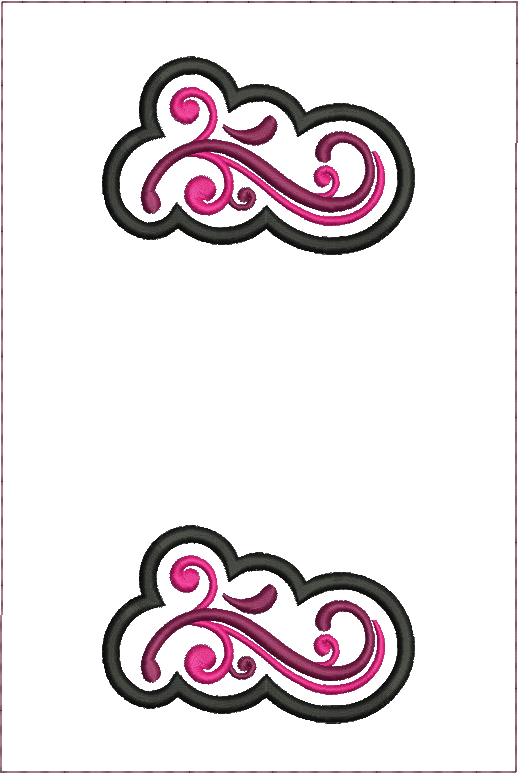
Once you have hooped the sticky back and the tear-away, unless you are just covering the hoop area with fabric to start, placement stitches will run on the sticky back to indicate where to lay the fabric:

Now, lay your interfaced and stabilized fabric in the hoop. The following basting box and tackdown stitches will run (I run 2 tackdowns to help alleviate any fraying of the fabric which happens often with the types of fabrics we use in Irish dance.):

Then the following knots will stitch out:

After the knots finish, I stop and remove the hoop for trimming. (I program a stop on a commercial machine.)
Remove the hoop from your machine. Cut very closely to the outside stitching as shown below (obviously using different examples!):

Then, put the hoop back on your machine and finish the outside satin stitching:
 At this point, the patches may start to separate from the sticky back which is why you do not want to have pulled the sticky too tightly when attaching it to your hoop. If it is too stretched, the patch will definitely pull away and shift and the final satin stitching will be faulty.
Using other patches as an example, I will show you how I finish them. Here, the patch stitching is done. You can see the perforations around the patches but no huge holes…the patches are still in the right place!

Before removing the patches, I run a line of Fraychek on the back edge of the of the outside satin stitching. Then, I punch them out.


As you can see, there is a fine fuzz surrounding the patches. This is from both the sticky and tear away stabilizers. This needs to be trimmed away using either use my appliqué scissors or my fine, curved embroidery scissors.

Here they are trimmed. I can get closer with the smaller scissors…obviously the trick here is to trim closely without cutting threads which the Fraycheck actually helps with as it has sealed the edges which protects those threads. Since the edge embroidery thread is white, this is where I stop. When the outside satin stitch is a colored thread, I use either a permanent Sharpie or a fabric dye pen in the right color prior to applying the Fraycheck, and I color in the outside edge so all the white is gone, then trim when it is dry.


I sometimes then iron a fusible web to the back of the applique to hold the patch securely in place when I the sew around the edge. My preferred way of sewing around the patch is to use a clear monofilament, and using the outside satin stitching as a guide, I use a wide zig-zag to attach the patch flush to the fabric.

![[Irish+construction+001+(Small).jpg]](https://taoknitterarts.com/wp-content/uploads/2009/11/irish2bconstruction2b0012bsmall.jpg?w=300)
![[Irish+construction+005+(Small).jpg]](https://taoknitterarts.com/wp-content/uploads/2009/11/irish2bconstruction2b0052bsmall.jpg?w=300)
![[Irish+construction+006+(Small).jpg]](https://taoknitterarts.com/wp-content/uploads/2009/11/irish2bconstruction2b0062bsmall.jpg?w=300)
![[Irish+construction+010+(Small).jpg]](https://taoknitterarts.com/wp-content/uploads/2009/11/irish2bconstruction2b0102bsmall.jpg?w=300)
![[Irish+construction+011+(Small).jpg]](https://taoknitterarts.com/wp-content/uploads/2009/11/irish2bconstruction2b0112bsmall.jpg?w=300)
![[Irish+construction+008+(Small).jpg]](https://taoknitterarts.com/wp-content/uploads/2009/11/irish2bconstruction2b0082bsmall.jpg?w=300)
![[Irish+construction+007+(Small).jpg]](https://taoknitterarts.com/wp-content/uploads/2009/11/irish2bconstruction2b0072bsmall.jpg?w=300)
![[Irish+construction+013+(Small).jpg]](https://taoknitterarts.com/wp-content/uploads/2009/11/irish2bconstruction2b0132bsmall.jpg?w=300)


 Taoknitter Arts